



Electricians are trained to see what most of us miss: not just a tangle of wires, but a system of signals — and colour is one of the most important tools in that system. Wire colours aren’t decorative; they’re vital for safety, function, and legal compliance. Misreading them can trip a breaker — or cause something far worse.
Let’s break down what those colours mean in the UK and why you should care.
🇬🇧 UK Wire Colour Codes (Post-2004 Standard)
In the UK, fixed wiring in buildings follows the BS 7671 wiring regulations, updated in 2004 to align with European (IEC) standards.
| Function | Wire Colour |
| Live (Line) | Brown |
| Neutral | Blue |
| Earth (CPC) | Green/Yellow Stripe |
✅ This change improved safety and consistency across Europe — but it also means electricians need to be aware of both old and new systems.
⚠️ Pre-2004 (Old UK Colour Codes)
In older buildings (before 2004), you might still find:
- Red – Live
- Black – Neutral
- Green – Earth
Electricians working on mixed wiring systems (e.g. part-old, part-new) must be cautious and clearly label any re-identified wires.
🌍 International Wire Colour Differences
When dealing with imported equipment — or if you’re an electrician working internationally — it’s essential to understand other wiring conventions.
🇺🇸 USA / 🇨🇦 Canada (NEC Standard)
- Black or Red – Hot (Live)
- White or Gray – Neutral
- Green or Bare Copper – Ground
- Blue or Yellow – Also hot (used in switch legs or traveler wires)
🇦🇺 Australia (AS/NZS 3000 Standard)
- Red – Active (Live)
- Black – Neutral
- Green/Yellow – Earth
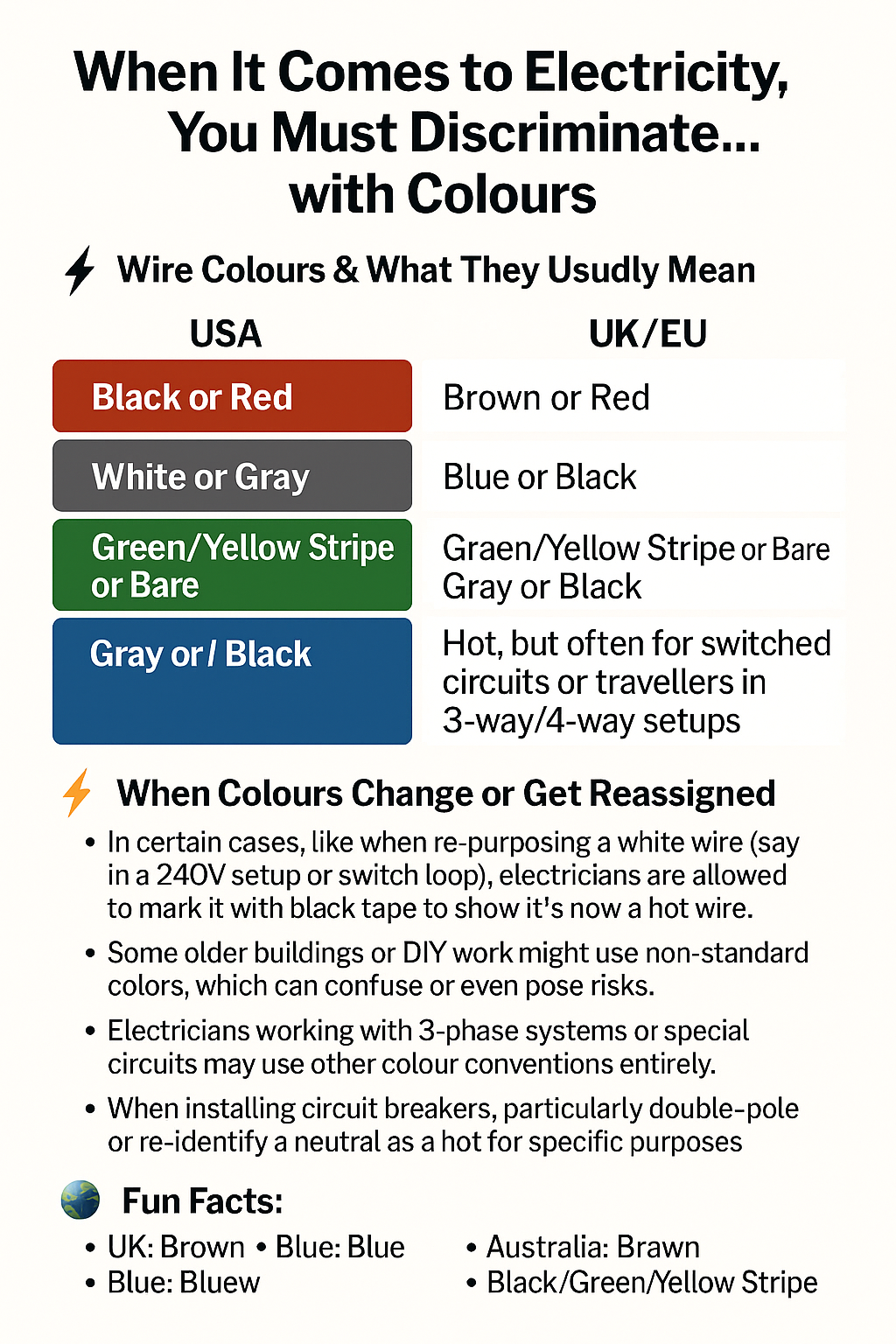 | ✅ In the age of global supply chains, you might encounter devices or components wired to international standards. For example, I once serviced a Chinese-made product that used unfamiliar colour codes — and the neutral wire didn’t function as expected!⚡️ When Colours Change or Get ReassignedWhile colour codes are a rule, they’re not set in stone:A white or blue wire might be re-identified as hot (live), especially in switch loops or specific circuits. In these cases, electricians mark it with black or brown tape. |
- Older homes or DIY jobs often contain non-standard colours — which can be misleading or dangerous.
- In 3-phase systems or industrial settings, different colour schemes apply depending on voltage, country, and installation type.
- Some setups, like double-pole breakers, may use two hot wires and re-identify a neutral if needed.
🧠 Final Thoughts: Respect the Code
Wire colours are a language, and electricians are fluent. If you’re not, don’t guess. Always:
- Test wires before touching
- Label wires clearly during work
- Follow local codes to the letter
Next time you peek behind a socket or switch, remember: it’s not just a tangle of spaghetti — it’s colour-coded electricity with a purpose.